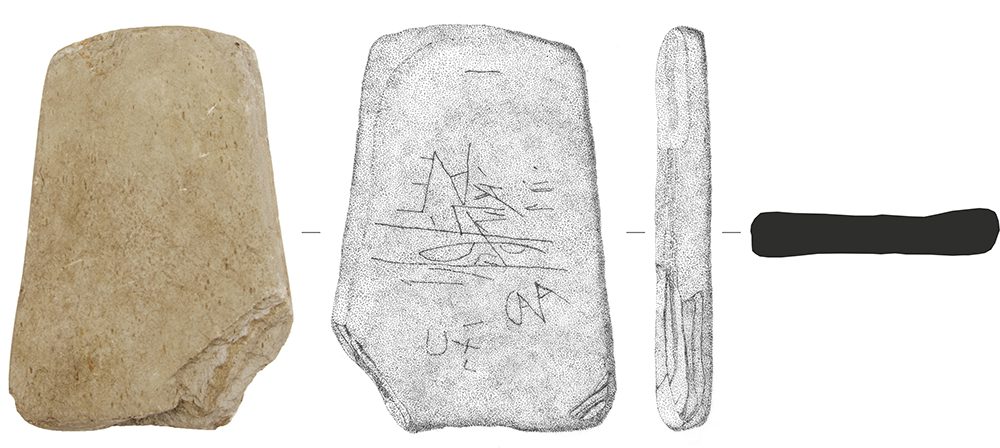
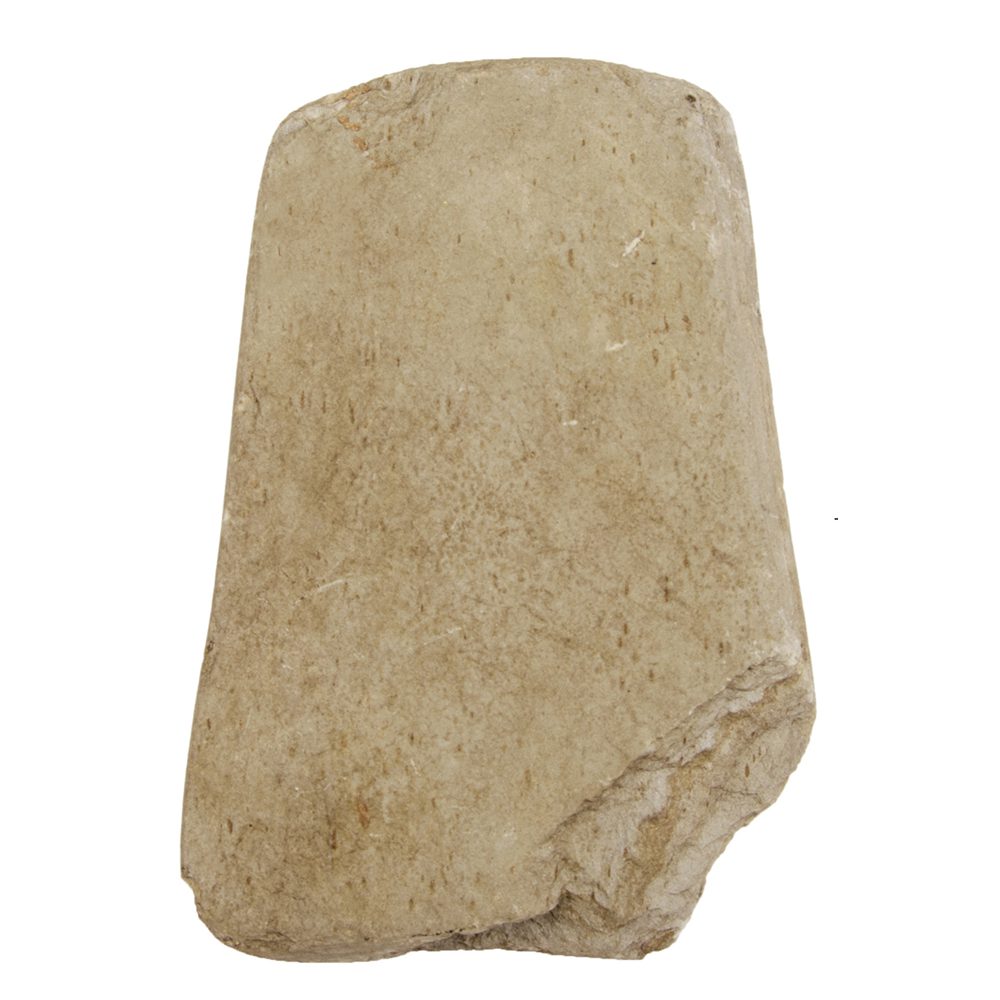
Schist polishing stone of sub-trapezoidal shape, fragmented at the lower corners. Rounded edges and intense polishing on both faces, with clear traces of use resulting in small depressions caused by friction. One face preserves several V-profile incisions, as well as two graffiti.
The first, reading AVE, represents a greeting and is executed as a ligature, in which the letter V is formed by the right stroke of A and the vertical element of E, slightly leaning to the right. The graffito is positioned centrally but does not align with the longitudinal axis of the object.
The second graffito, likewise off-centre and slightly inclined to the left, records the anthroponym Camalus, written as a ligature in which the letter M is constructed from the strokes of two As (CAMA(LVS)). This name is widely attested in pre-Roman onomastics and is considered to be of Indo-European origin, particularly associated with Lusitania and Vettonia.