
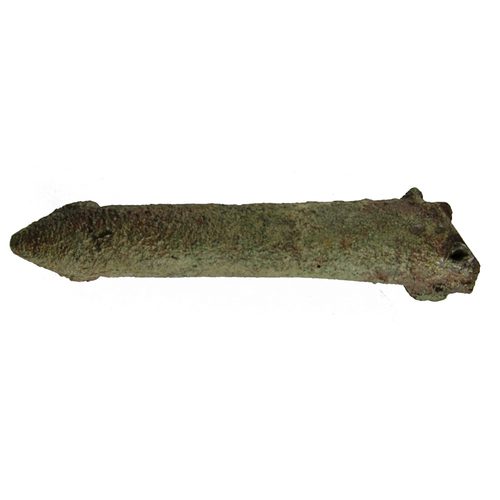
Handle of a ritual patera, comparable to type Boesterd 73. Cylindrical in form, terminating in a stylised animal head, identifiable as a ram by its characteristic horns. The handle is not entirely solid, with a longitudinal cavity along its underside extending through the length of the piece. The attachment end is slightly thickened and perforated for rivets, two of which are preserved in situ. The distal end, corresponding to the animal head, is pointed and features a transverse perforation on its underside, probably intended for suspension.
The most common examples represent, with varying degrees of realism, a ram’s head, although representations of dogs are also known, such as that from the Castro of Fiães (Vila da Feira) (CORTEZ, 1950, 29; ALMEIDA; SANTOS 1972, 14, est. II, no. 10). The present specimen, although highly stylised, represents a ram’s head, the most distinctive elements being the two semi-circular projections forming the horns. It includes a transverse perforation at its distal end, likely intended for suspension. Its attachment to the patera was achieved by rivets, still preserved, revealing a solution comparable to examples from Conímbriga (ALARCÃO; PONTE 1979, VII, 155, est. XXXVIII, no. 19 & 20), which show notable similarities. Another closely comparable example, morphologically identical, comes from Braga, discovered during an excavation conducted by R. Santos da Cunha in 1964 and published by Rigaud de Sousa in 1966 (RIGAUD SOUSA 1966, 589-599). This piece, also a bronze patera handle terminating in a stylised ram’s head, shares the same defining feature – prominent horns – and is currently housed in Braga’s Museu dos Biscainhos.