
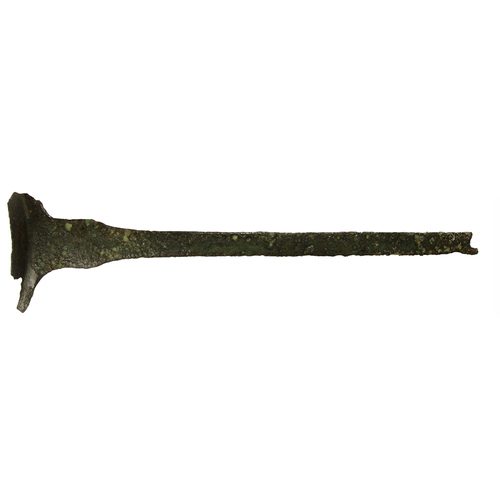
Handle and rim fragment of a saucepan. The handle, of rectangular section, terminates in a suspension ring and maintains this configuration up to near the rim, where it widens slightly, briefly resumes a rectangular section, and then widens again to merge with the rim, which presents a slight horizontal flange.
Saucepans and strainers are frequent finds in domestic contexts and form part of the wide range of metal kitchen utensils. Although highly fragmentary, this saucepan preserves part of the rim, the start of the wall and a fragment of the base. The artefact cannot be assigned to either the Boesterd or Eggers typological systems. It shows morphological similarities to example no. 21 from Conímbriga (ALARCÃO; PONTE 1979, 155, 157, est. XXXVIII, no. 21), which shares a comparable chronological framework. Another morphologically close example was found in the late Roman villa of Titi Juan de la Cruz (Pinto, Madrid), in which the handle also shows a triangular expansion at the junction with the vessel (CABRERA; OVEJERO; GONZÁLEZ; PABLOS; COBO; BAZTÁN; VÁZQUEZ 2001, 186, fig. LXXII, no. 641).