
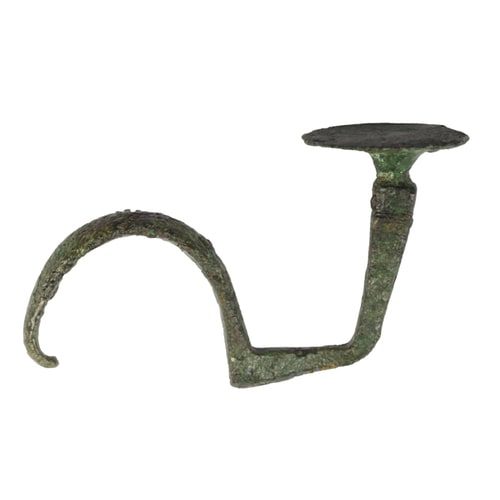
Fibula with plano-convex bow. Foot of quadrangular outline with progressive thickening, terminating in a wide disc with collar. The hinge and pin are missing. Catch plate perpendicular to the bow with curved support. Spring and needle not preserved.
Sabroso-type fibulae take their name from the eponymous site where approximately ten examples were identified (FORTES 1905/08, 18, fig. 19). They are considered an indigenous production of post-Hallstatt influence, introduced into the castro culture from the 5th century BC. Their period of greatest circulation appears to extend from the mid-1st century BC to the mid-1st century AD (SILVA 1986, 189).
Although widely distributed across the Iberian Peninsula, this fibula type shows a high concentration within the castro region, being recorded in more than a dozen castros (PONTE 1980, 116-117, fig. 2; SILVA 1986, 188, graph 5; est. CI, no. 3-14), which has led some authors to interpret such distribution as evidence for the existence of a production centre. Armando Coelho suggests the Citânia de Briteiros, Guimarães, as a potential production site, based on the presence of an example in an intermediate stage of manufacture and the predominance of this type at the site (SILVA 1986, 188-189).