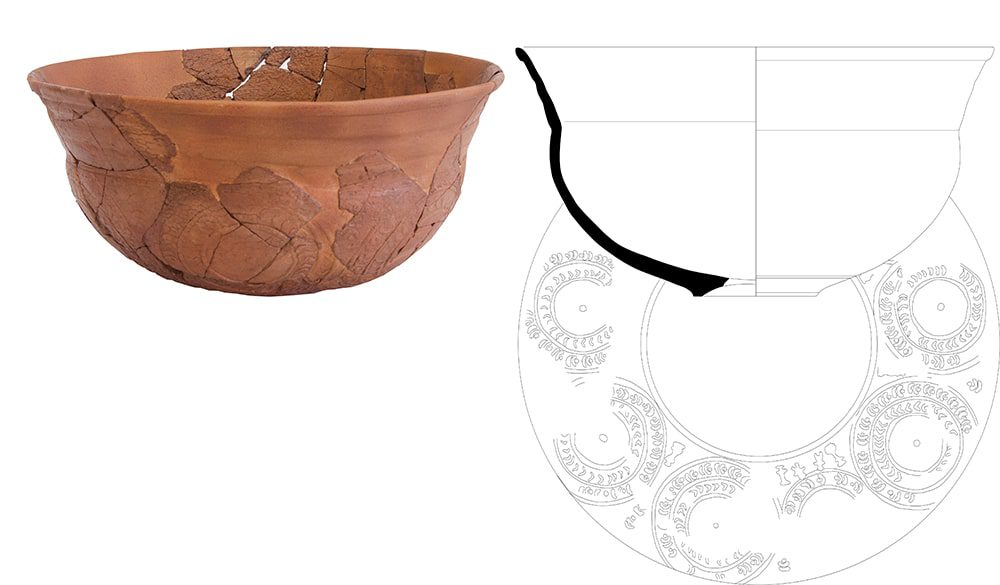
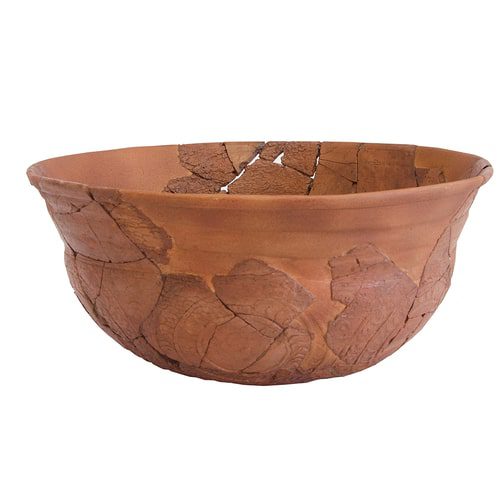
Dragendorff 37 (Late) bowl, variant B, decorated in the second decorative style. Bell-shaped profile with wall structured in two planes: the lower corresponding to the body, and the upper forming the rim wall, which is straight and obliquely developed. The rim terminates in a rounded lip of oval section. The base consists of a false ring foot, low and short, with radial resting surface and moulding typical of Ebro Valley productions (MAYET 1984, 257). The decoration is restricted to the middle and lower zones of the body, arranged in a band parallel to the rim. Motifs consist of circles separated by bars. The circles contain two internal bands containing crescents separated by dots. The composition is asymmetrical, terminating in a smaller circle.
Dragendorff 37 (Late) vessels are usually characterised by a slightly concave wall, a high and open rim, and a low foot. Numerous variants exist, particularly in rim morphology, which have led to different typologies. Following Françoise Mayet, two main groups may be distinguished: mould-made vessels (A and B) and wheel-thrown imitations (C and D). A detailed consideration of the differences identified by Palol, already taken into account by López Rodríguez (RODRÍGUEZ 1985, 21–22), and currently followed by most authors, shows that variants A and B are distinguished by the presence or absence of a lip. According to the criteria adopted by Paz Peralta, type A is characterised by a high and open rim tending towards verticality with a plain lip. Type B corresponds to vessels with an open and straight rim finished with a rounded lip, as in the present example.