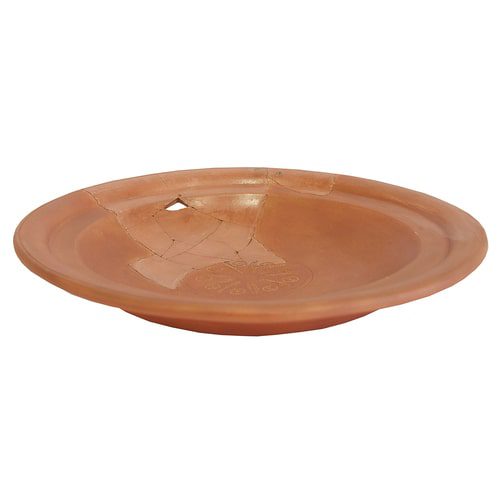
Fragments comprising rim, wall and base, which allow reconstruction of the complete profile of a Hayes 67 dish. Moulded and rising rim, forming a slightly descending flange terminating in a thick lip marked internally by a groove. Sinuous profile with curved walls and flat base, externally defined by a deep groove forming a false foot. Decoration delimited by a circle, composed of stamped motifs of Hayes style A, specifically style A (ii).
The Hayes 67 dish is considered one of the most widespread forms in the second half of the 4th century. It is characterised by a moulded and rising rim and thick lip, frequently marked internally by a groove. It typically has a sinuous profile with curved walls and a flat base marked externally by a deep groove forming a false foot. When decorated, the stamped motifs belong to style A. Hayes puts forward a general chronology between AD 360–470 for its dissemination, distinguishing three groups based on decoration: AD 360–420 for style A (ii); AD 400–450 for style A (iii); and circa AD 450 for simplified motifs consisting of a single element (HAYES 1972, 112-116, fig. 19).