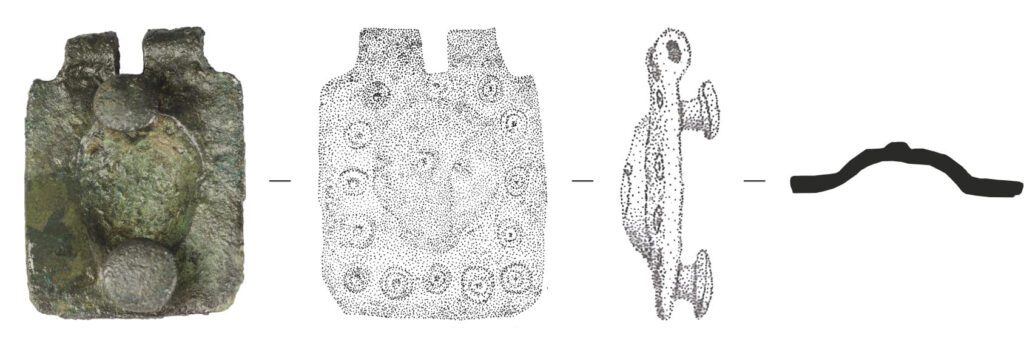
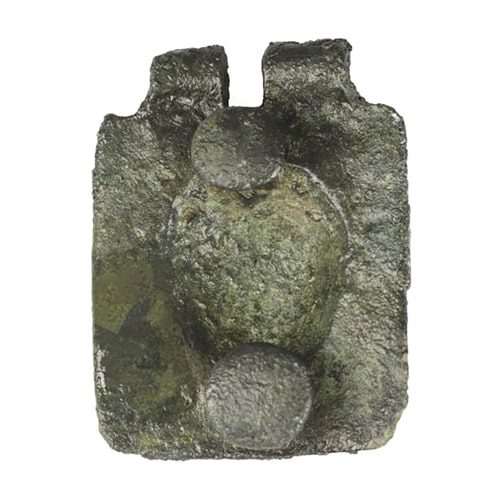
Rectangular belt fastener with two prongs for attachment on the front face. The piece is manufactured from a single sheet and terminates in a hinge formed by rolling and soldering, creating two perforations through which an axis pin would have passed to operate the fastening mechanism. The prongs served to secure the opposing element of the belt. The decoration on the plate consists of geometric motifs arranged along the border, made up of two concentric circles with a central point, produced by punching with a matrix. At the centre, in relief, there is a crudely rendered face, with emphasis on the chin, nose and eyes.
The piece displays clear morphological and stylistic affinities with Late Roman materials from the Douro Valley. Comparable decoration is found on a belt plate from the archaeological site of La Bienvenida, Ciudad Real, dated to the 5th century (AURRECOECHEA; FERNANDÉZ; KLINK 1986, 255, est. I, no. 8). The same formal and decorative language is also present in a peltiform buckle from Monsanto, Idanha-a-Nova, featuring two confronted animals (lions?) (PONTE, MARQUES 1980, 60-61, fig. 2). According to the typological framework established by Sommer (SOMMER 1984) and further subdivided by Bohme (BOHME 1986, 482-485), this specimen belongs to the Sissy type, a group primarily distributed in Gaul and characterised by confronted lion-head motifs.