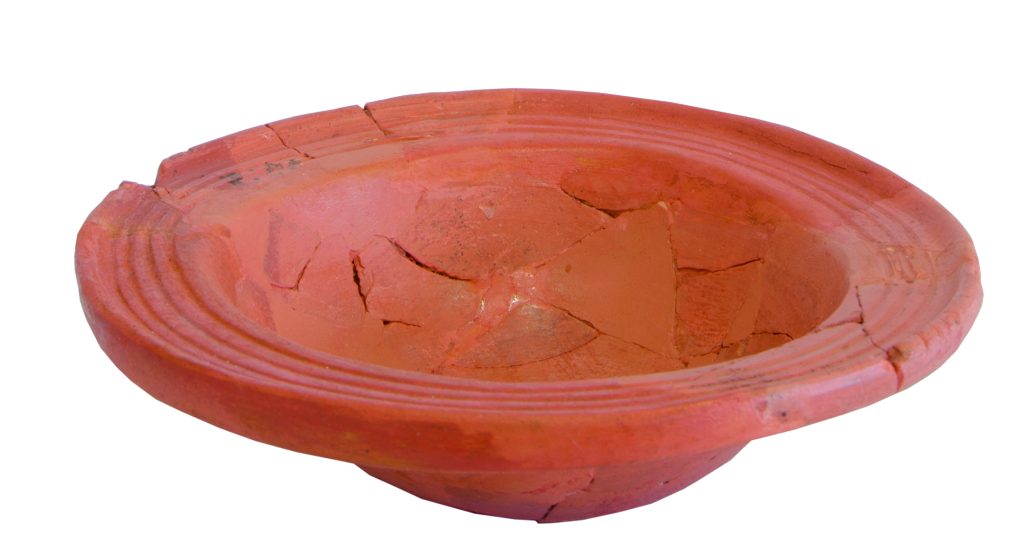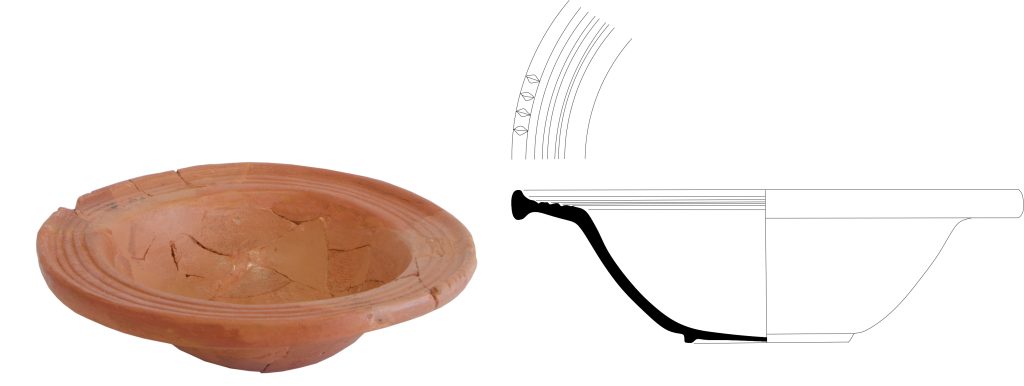
Hayes type 73 vessel. Slightly descending horizontal flange, with three rectangular-profile grooves, parallel to one another. Vertically developed almond-shaped lip, decorated with groups of four transverse grooves of trapezoidal form. Incurving wall, slightly curved. Base composed of a short ring foot with radial resting surface, of rectangular section and angular edges.
The Hayes 73 form (HAYES 1972, 121–124, fig. 21) is characterised by a curvilinear profile, a horizontal flange with three parallel rectangular grooves, and an almond-shaped lip decorated with groups of four trapezoidal transverse grooves. Although Hayes dates its production between AD 420 and 475, examples are attested at Moosberg, Germany, in stratigraphic levels dated to the end of the 4th century. The form is particularly widespread in continental Europe, with occurrences in Tarragona (CARANDINI; TORTORELLA; SAGUI; TORTORICI 1981, 73), Mérida (VÁZQUEZ 1987, 44), and Saragoza (PERALTA 1991, 195, fig. 85, no. 79). The closest parallels, relevant for comparison and chronological framing, are from Conímbriga (DELGADO 1976, 256-257, est. LXXII, no. 86), and are dated to the second half of the 5th century.