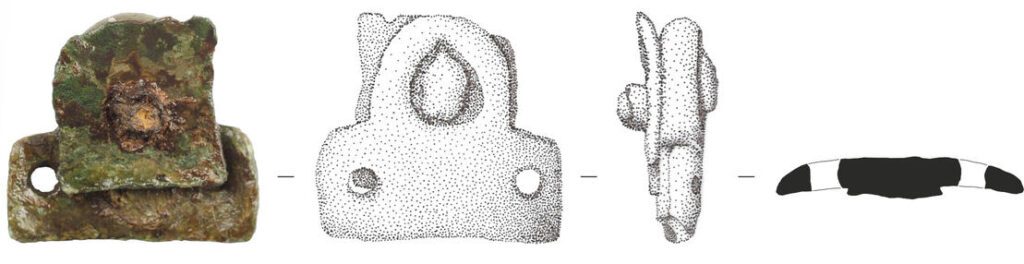
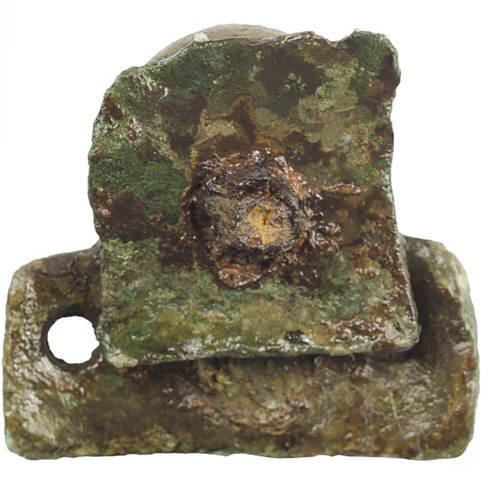
Rectangular belt fastener with slightly rounded shoulders and a terminal ring. Opposing fastening element also in bronze, of quadrangular form, with a curved iron prong. Two lateral perforations for attachment to the belt by means of rivets.
Although morphologically distinct from other examples of the same period, its functional mechanism appears consistent with comparable artefacts, as supported by its dating. The material from Alvarelhos shows clear connections with finds from the Douro Valley, particularly the necropolis of Simancas and Fuentespreadas, and, to some extent, contributes to challenging the notion of a late Roman “Douro subculture”. The interpretation of these objects as military equipment of Romano-Germanic affiliation, originally advanced by Palol (who proposed the existence of a Late Roman limes along the Douro defended by Germanised troops), was later developed by Caballero Zoreda, who subdivided this so-called Douro subculture into several regional groups, including the Foz do Douro area (ZOREDA 1974, 186). A. Fuentes Domínguez, however, has convincingly challenged the military interpretation of the “Douro necropoles”, demonstrating that the distribution of these materials extends across much of present-day Portugal and into the Submeseta Sur. Studying this Spanish region, Aurrecoechea Fernandéz (FERNANDÉZ 1995/96, 49-99) has documented these artefacts in settlement contexts such as villae and urban centres, thereby undermining their strictly military interpretation.