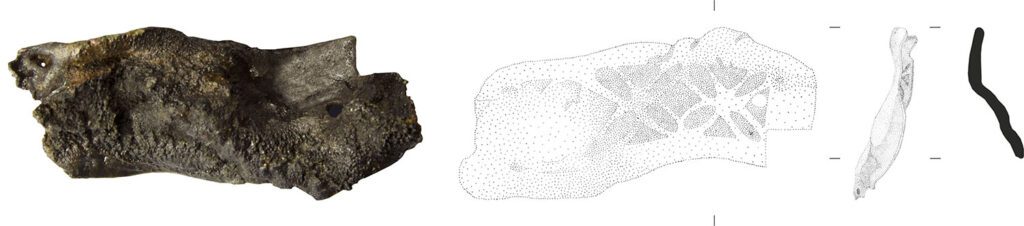
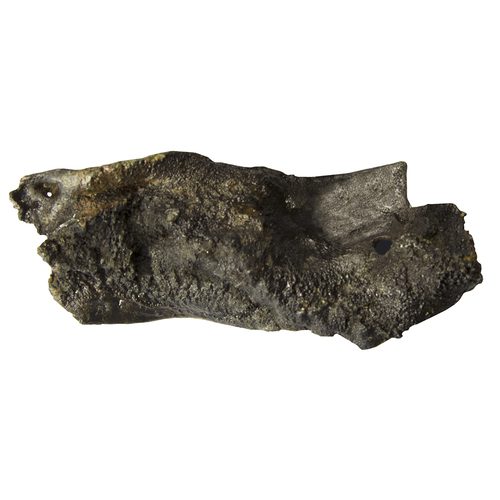
Fragmented rectangular bronze plate with a perforation at one extremity. Decoration in low relief composed of geometric motifs, including triangles and oval leaves forming a star, connected by a triangular pattern repeated three times.
Only the plate survives from the original set, which included a buckle. No traces of the hinge or fastening studs remain. The decorative low relief fully perforates the plate in some areas.
Due to its size, it cannot be directly associated with Simancas-type buckle plates, typically narrow, which Pérez Rodríguez and M. Aragón relate to the trans-Pyrenean cingula of the first half of the 4th century (RODRÍGUEZ; ARAGÓN 1992). The decoration of the cingula, composed of repeated motifs frequently including arches, horseshoes and serpentiform elements, usually fully perforated, also distinguishes it from the present example, although technical and stylistic affinities are clear.
Although no regional parallels have been identified, its affiliation with materials from the Douro Valley is evident, particularly those from Villasequia de Yepes, Carpio de Tajo (FERNANDÉZ 1995/96, 55, n.º 1-4).