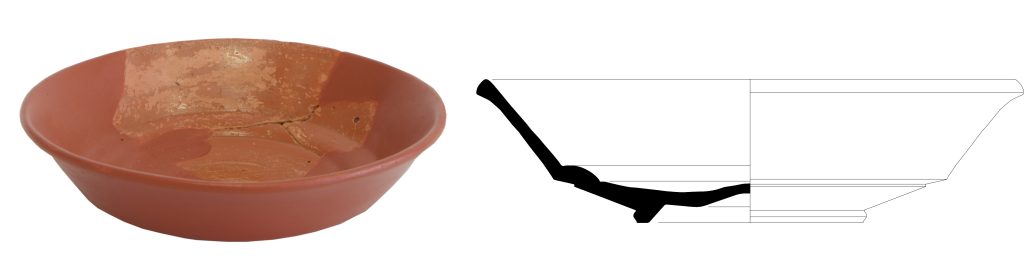
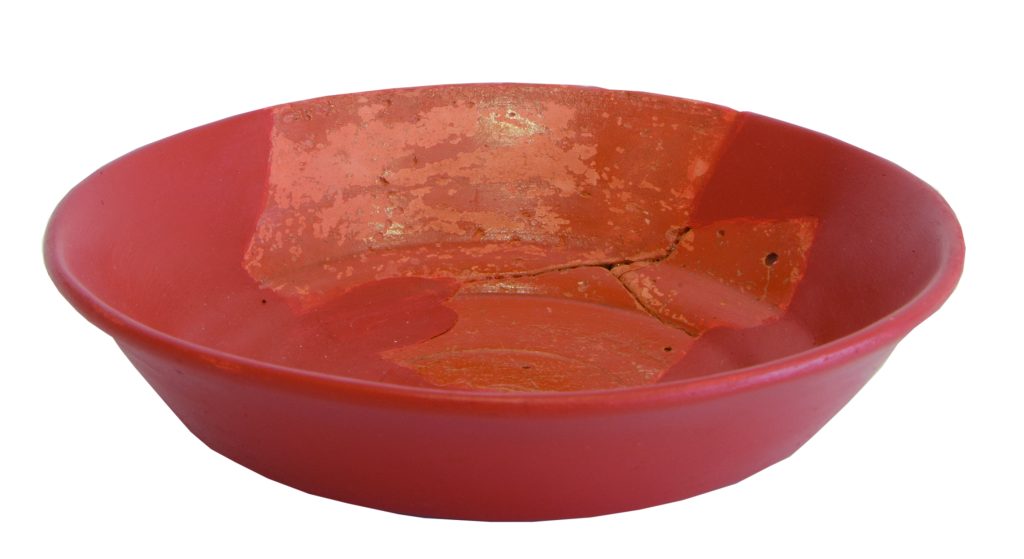
Dish of Dragendorff type 15/17. Rim and wall of a wheel-thrown vessel. Straight, slightly concave wall, projecting outwards and terminating in a rim with rounded lip. External carination marked by a groove and channel, corresponding to the internal groove, which is broad and shallow. Interior base with a panel bearing an illegible sigillum. Low foot of triangular section and concave base, with Hispanic moulding.
The Hispanic Terra Sigillata vessel of Dragendorff type 15/17 represents a long-lived form that evolved from the South Gaulish model, going through significant variation in profile and size throughout its development. This morphological evolution progressively altered its original characteristics, setting it apart from the South Gaulish prototypes until it took on a distinctly different form. The various stages of this transformation and their chronological attribution remain debated among scholars. Mezquíriz distinguishes two types: the first, closer to the South Gaulish prototypes, with an open wall and a clearly defined junction between wall and base; the second, more evolved, with a more open, biconical profile (MEZQUÍRIZ 1961, 54-55, est. 1). Françoise Mayet subdivides the evolutionary stages into four groups (MAYET 1975, 183-184; 1984, 71, est. LVII-LX). Finally, Romero Carnicero, based on Hispanic Terra Sigillata from Numantia, not only defines three groups according to formal characteristics, but also associates them with specific chronologies (ROMERO CARNICERO 1985, 188-190), a framework subsequently adopted in later studies (VAQUERO 1998, 562-567).