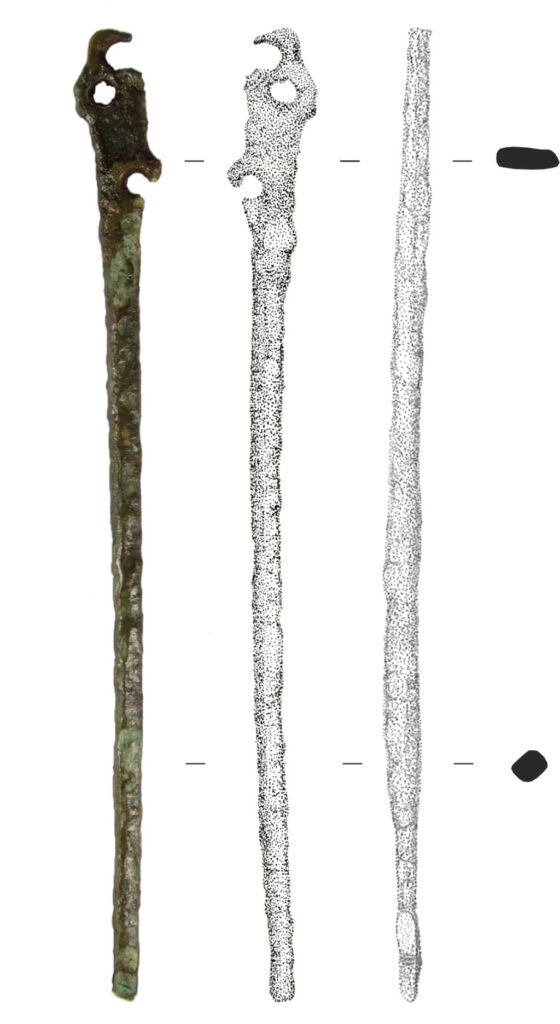
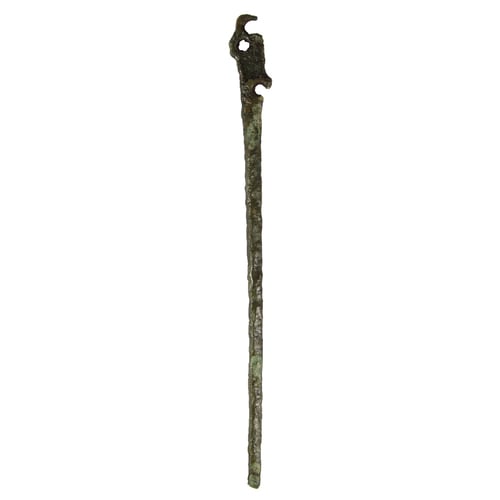
Hairpin. Head in the form of a perforated plate with three holes for the suspension of pendants. Shaft of cylindrical profile, tapering progressively towards the tip.
Hairpins, generally designated as acus, had multiple personal uses, such as fastening garments or, more frequently, securing hairstyles, in which case they functioned as ornaments and are referred to as acus crinalis or comatoria. They were manufactured in a wide range of materials, including bone, wood, ivory, bronze, copper, iron and precious metals.
Although frequently found in domestic and funerary contexts, they are only sporadically and briefly referenced in the literature, making it difficult to establish parallels that allow precise chronological assessment or the definition of morphological and stylistic characteristics. This specimen can be classified as Beckmann type 136/137 or as Group B type X according to Elsa França (BECKMANN 1966, 39 est. 4, no. 136-137; FRANÇA 1968, 71).