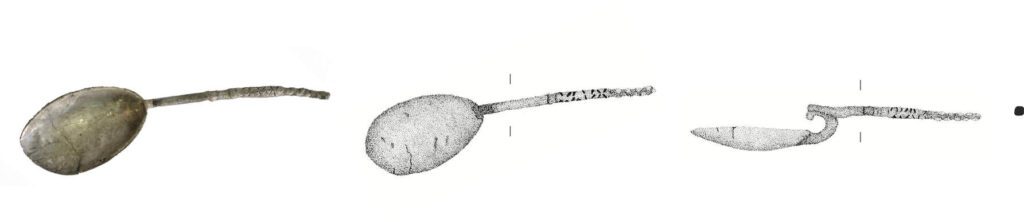
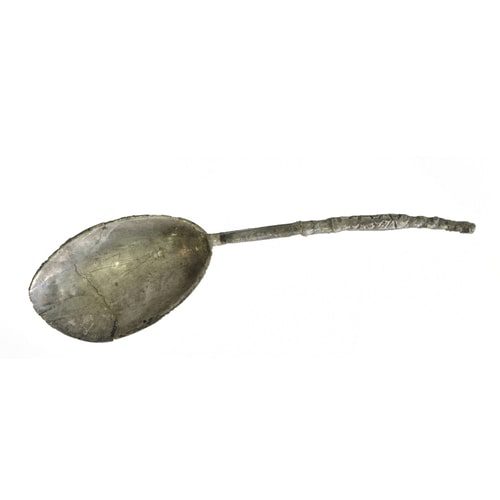
Spoon with an oval bowl and a shaft of quadrangular section, tapering progressively towards the terminal. The junction between shaft and bowl is formed by a volute, creating two distinct planes.
The decoration on the shaft occupies approximately two-thirds of its length and consists of a geometric design of incised lines.
Silver spoons are widely attested across Central Europe, England and the Iberian Peninsula and have been attributed a range of domestic uses, including those related to personal hygiene, such as the handling of unguents and perfumes, as well as pharmaceutical applications involving the preparation, dosing and administration of medicines.
A religious function has also been proposed for certain examples, particularly in relation to early Christian practices.
García y Bellido suggests that some may have been used in the Eucharist, following Near Eastern traditions preserved in the Orthodox Church (BELLIDO 1971, 95).
The inscriptions frequently found on many such objects, including vivas in Deo or vivas in Christo, often preceded by a personal name, suggest a connection with baptismal rites, as in the spoon from Terrugem, Elvas, which bears the name Elias (DEUS; LOURO; VIANA 1955, 572, fig. 2, 19–24). These inscriptions may have served to commemorate the baptism and mark ownership by the individual, explaining both the domestic and funerary contexts in which many of these objects are found.
The use of precious metal further supports this interpretation, since bronze examples do not preserve such acclamatory inscriptions. The choice of material may thus reflect an intention to enhance the significance of baptism as a central moment in Christian life.
Their preservation, much like devotional objects today, appears to be associated with beliefs in divine protection, with attributed prophylactic or curative properties, similar to medals or scapulars (BELLIDO 1971, 96).
Chronologically, these objects are generally dated between the 4th and early 5th centuries (MELENDO 1998, 94; ALARCÃO; PONTE 1979, 161), although their use may have extended into the late 5th century, as indicated by the example recovered from the Roman villa of S. Miguel de Odrinhas, Sintra, whose second phase of occupation dates to the 5th century (SOUSA 1989, 182).